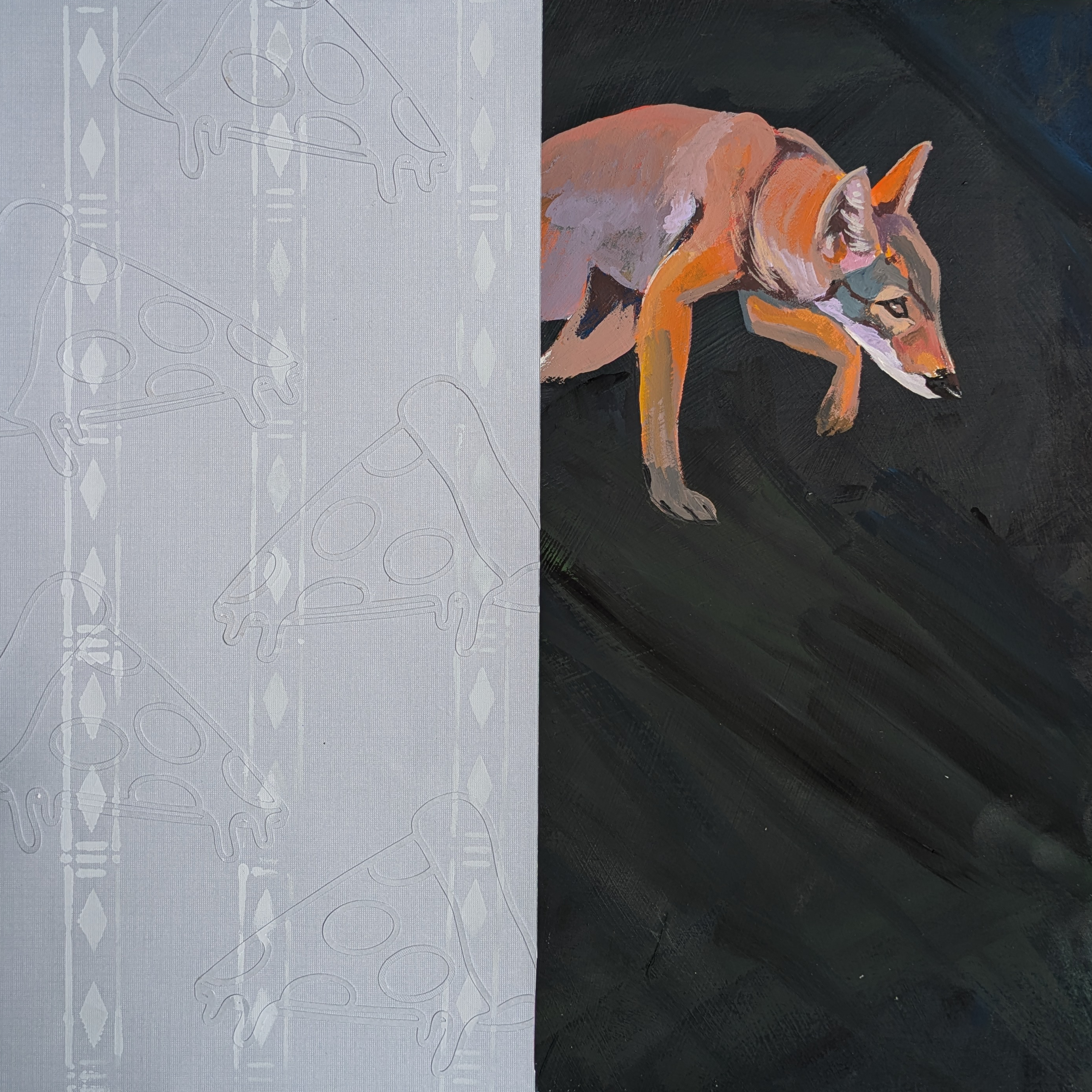
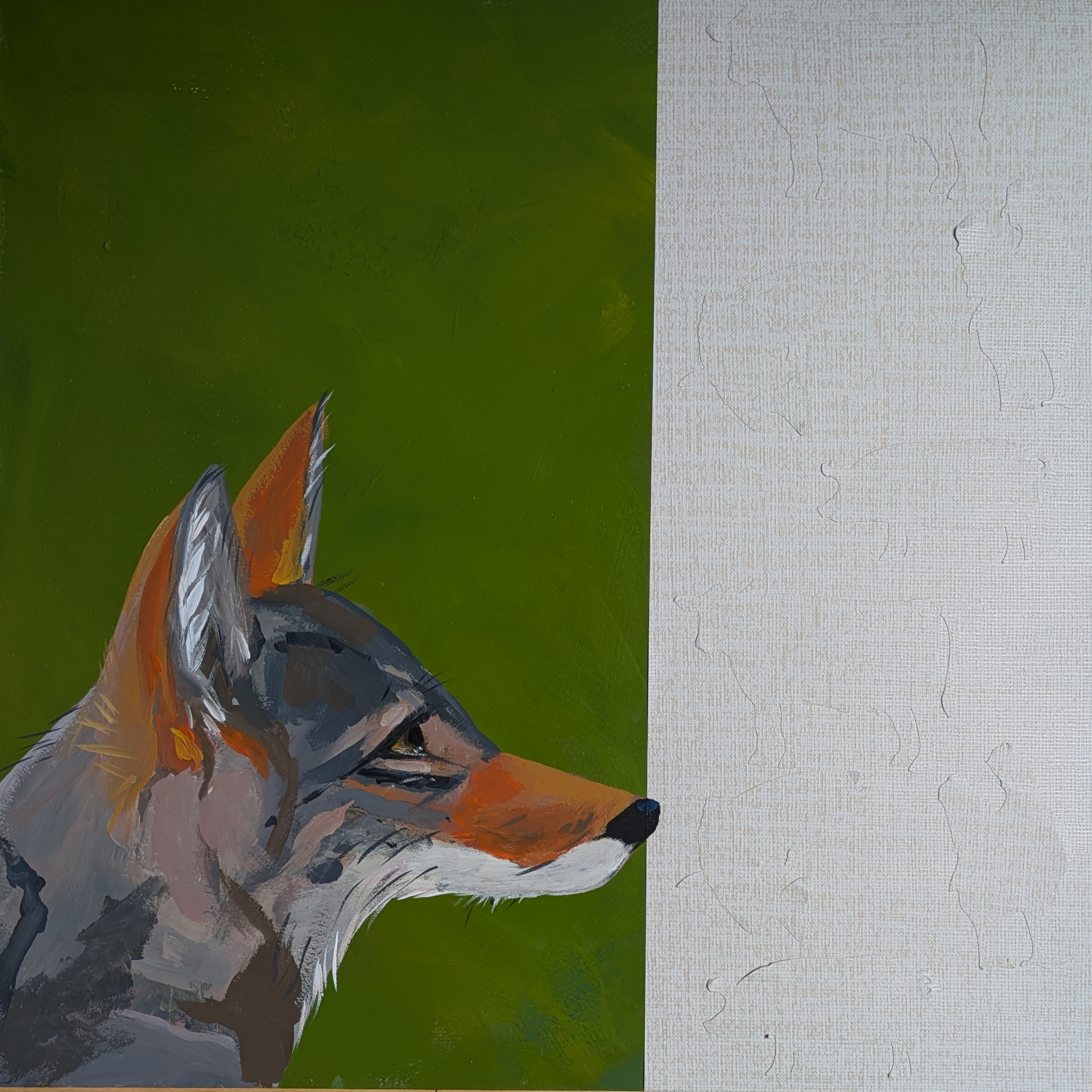
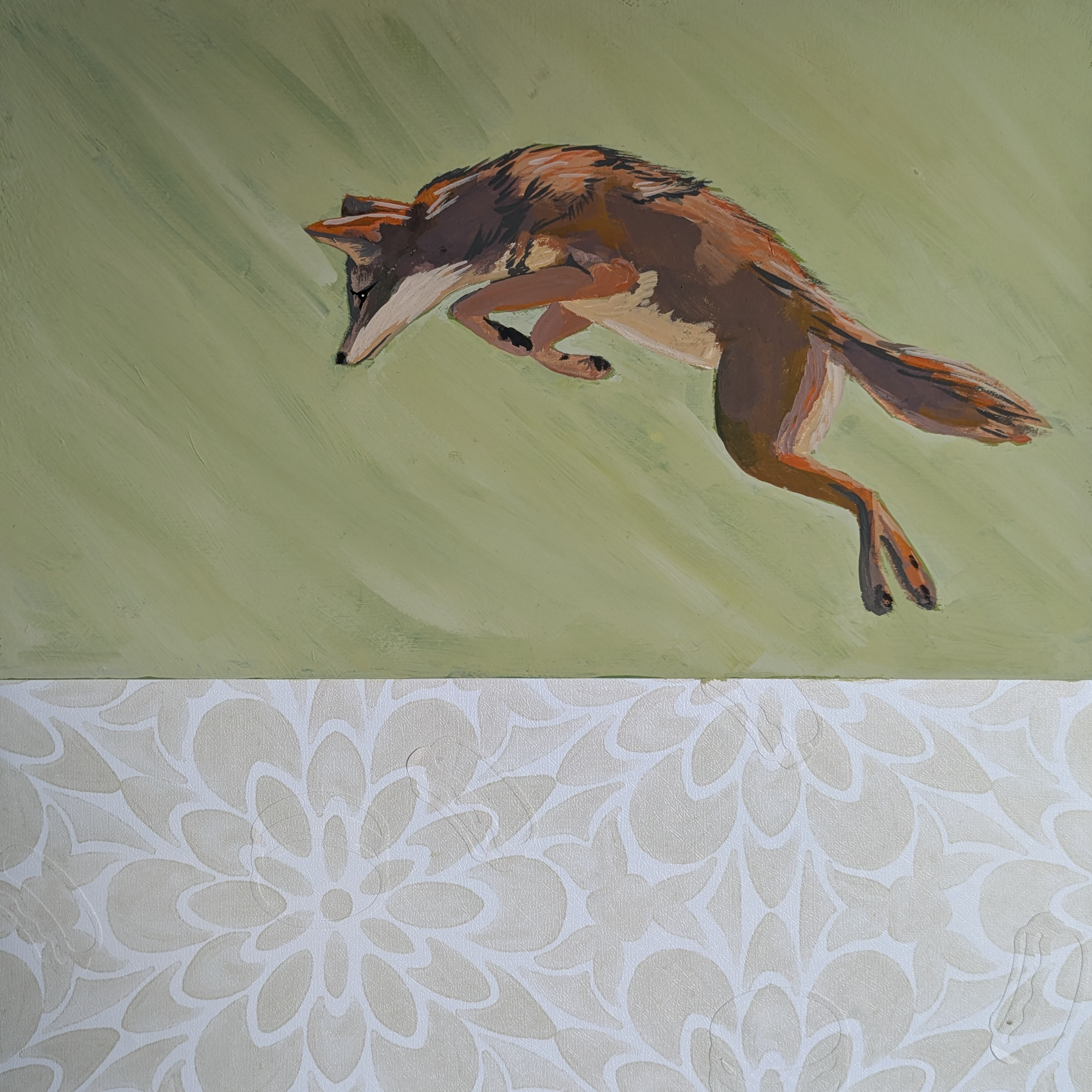
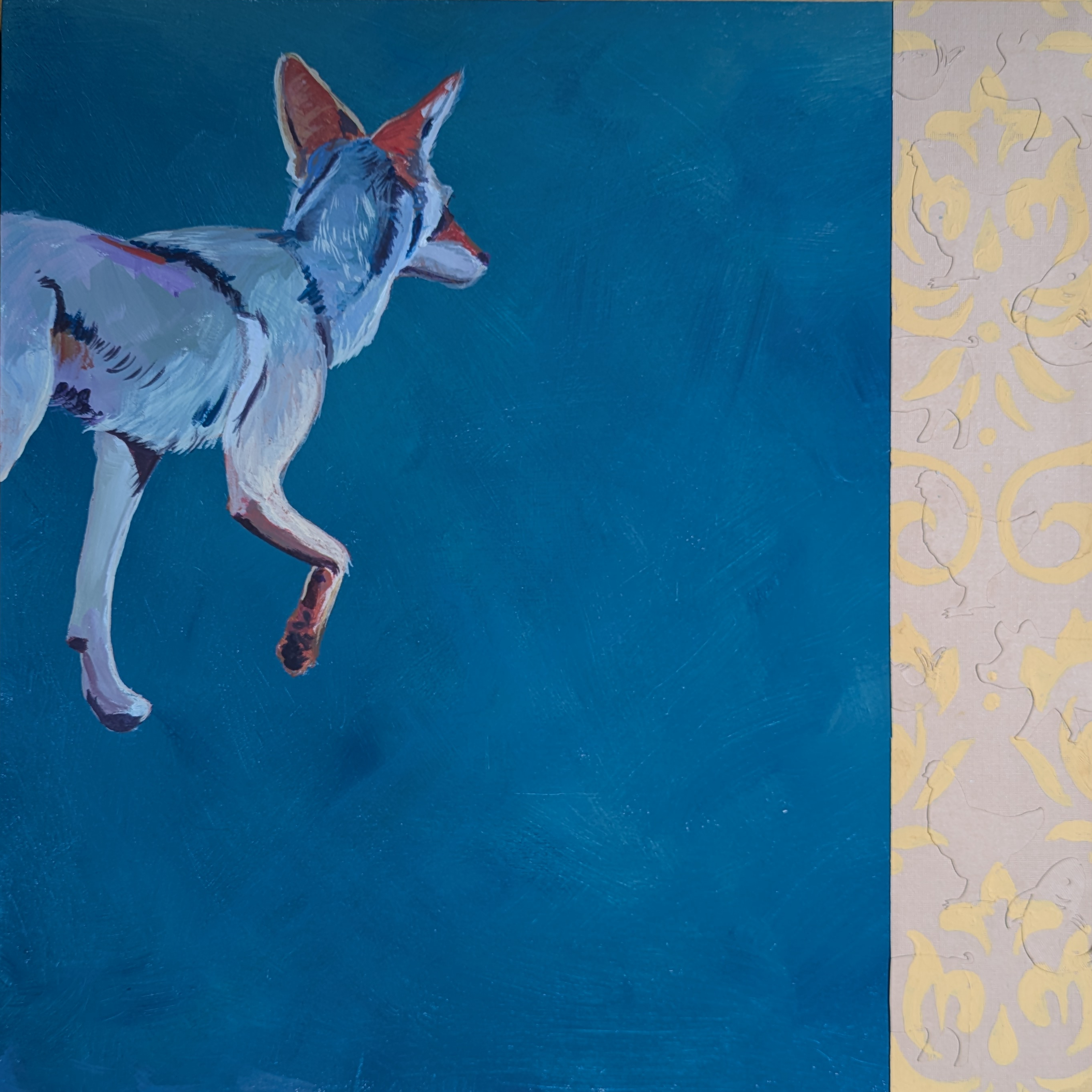
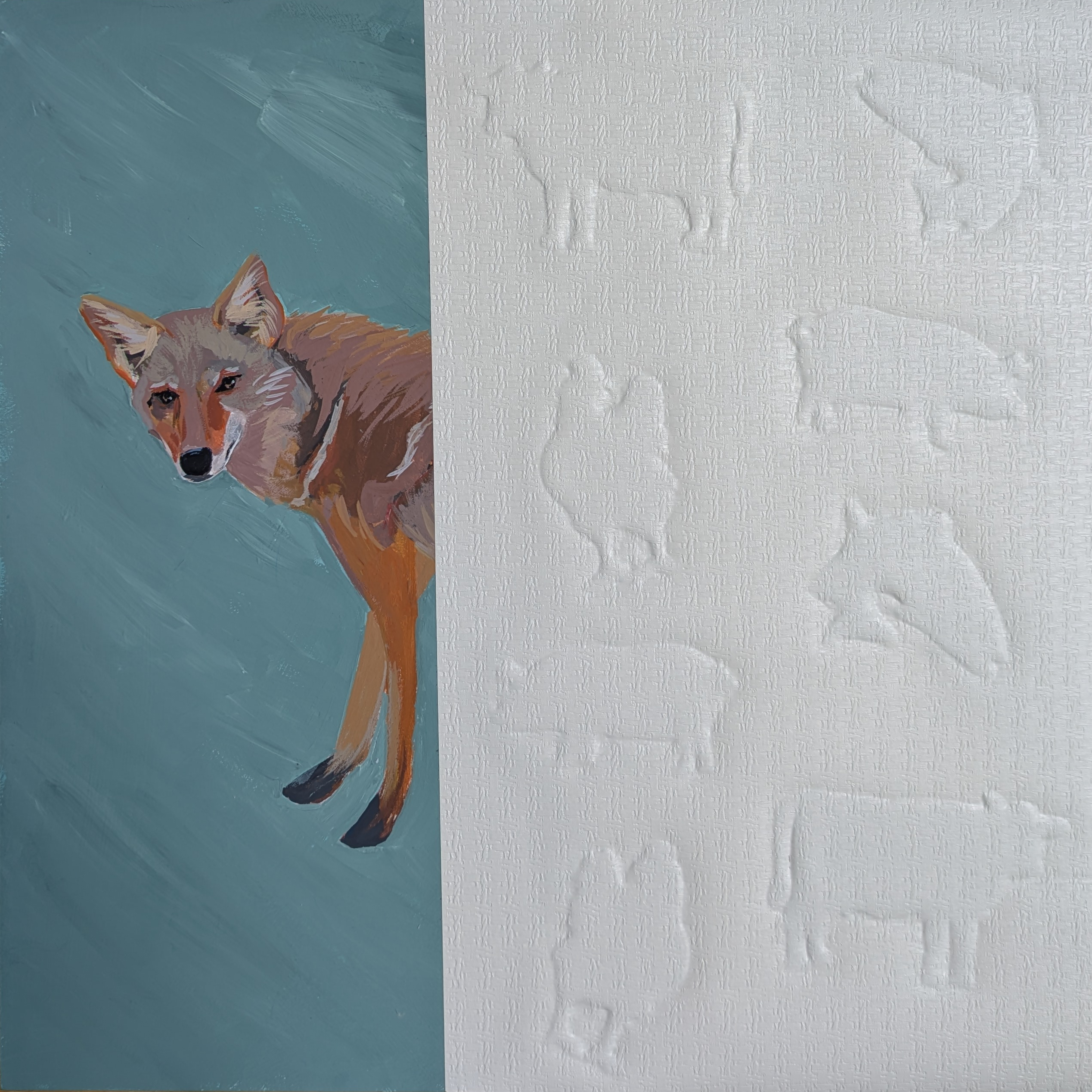
In collaboration with local urban ecologist Tali Caspi PhD, we presented a day of art and ecology. Exploring the interface between people and animals in the urban ecosystem of San Francisco, the show presented a series of visual works together with a talk discussing recent research in the habits of coyotes in the city.
The works consist of 10 paintings, featuring portraits of San Francisco's coyotes against a backdrop secreting data from Tali's research. The portion of the painting that contains a wallpaper motif represents the amount of diet in that area that is made up of anthropogenic (human) food sources. Viewers should compare and contrast different areas to see which allow coyotes to enjoy a more natural diet, with fewer human and pet food opportunities.
St. Francis Wood. Acrylic gouache, wallpaper, wood panel, 12 x 12 inch, 2025
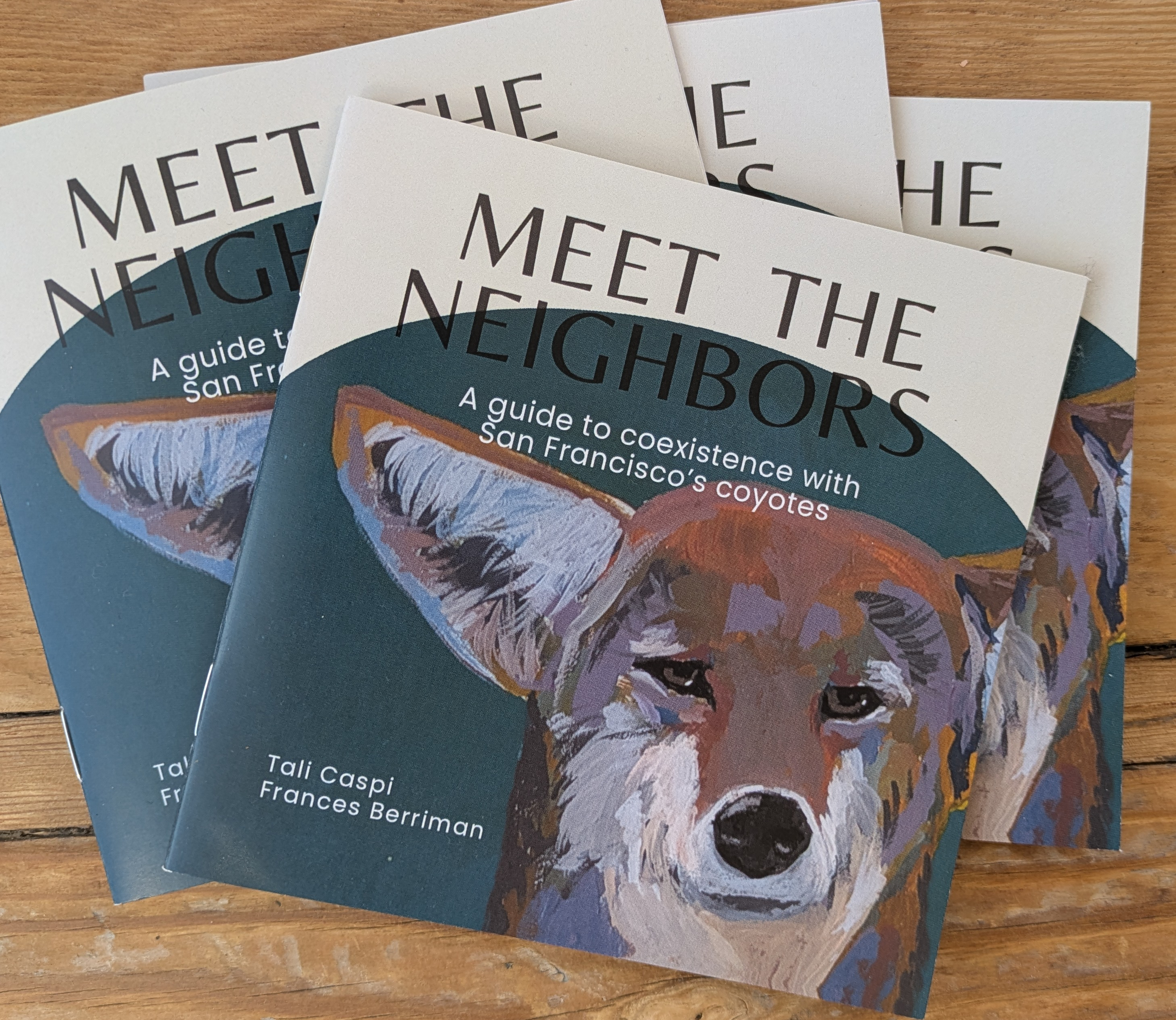
Meet the Neighbors. Printed booklet, 2025
To support the work, we produced a small handbook that both provides a keepsake of the paintings, coupled with information and advice on living in a city that has coyotes. The booklets have been used by San Francisco Animal Care and Control for educational purposes. If you would like a free copy, please reach out.
Read more about this work and Tali's research in this piece by SFGate.
References
The artwork and booklet are supported by research papers:
Caspi T, Serrano MG, Vanderzwan SL, Kessler J, Schell CJ, Sacks BN. 2025. Impervious surface cover and number of restaurants shape diet variation in an urban carnivore. Ecosphere, 16: e70152.
Gerraty, F.D., Carroll, T., Williams, S. and Isadore, M., 2024. Recovering predators link aquatic and terrestrial ecosystems: River otters subsidize coyotes with carrion. Ecology and Evolution, 14: p.e11444.
Wilkinson CE, Caspi T, Stanton A, Campbell D, Schell CJ. 2023. Coexistence across space and time: Social-ecological patterns within a decade of human-coyote interactions in San Francisco. People and Nature, 5: 2158-2177.
Sacks BN, et al. 2021. Pleistocene origins, western ghost lineages, and the emerging phylogeographic history of the red wolf and coyote. Molecular Ecology, 30: 4292-4304.
Greer M. 2021. Coyote management in San Francisco. Master’s Capstone – USF.
Gallagher AJ, Trull PF, Faherty MS, Freidenfelds N, Heimbuch J, Cherry MJ. 2019. Predatory behaviors of coyotes (Canis latrans) living in coastal ecosystems. Ethology Ecology & Evolution, 31: 198-204.
Reid, R. E., Gifford-Gonzalez, D., & Koch, P. L. .2018. Coyote (Canis latrans) use of marine resources in coastal California: A new behavior relative to their recent ancestors. The Holocene, 28: 1781-1790. https://doi.org/10.1177/0959683618788714
Reilly ML, Tobler MW, Sonderegger DL, Beier P. 2017. Spatial and temporal response of wildlife to recreational activities in the San Francisco Bay ecoregion. Biological Conservation, 207: 117-126.
Larson S, McGranahan DA, Timm RM. 2016. The Marin County livestock protection program: 15 years in review. Proceedings of the 27th Vertebrate Pest Conference, pp 59-68.
Sacks BN, Bannasch DL, Chomel BB, Ernest HB. 2008. Coyotes demonstrate how habitat specialization by individuals of a generalist species can diversify populations in a heterogeneous ecoregion. Molecular Biology and Evolution, 25: 1384-1394.
Sacks BN, Ernest HB, Boydston EE. 2006. San Francisco’s Golden Gate: A bridge between historically distinct coyote (Canis latrans) populations. Western North American Naturalist, 66: 263-264.
Sacks BN. 2005. Reproduction and body condition of California coyotes (Canis latrans). Journal of Mammalogy, 86: 1036-1041.
Sacks BN, Brown SK, Ernest HB. 2004. Population structure of California coyotes corresponds to habitat-specific breaks and illuminates species history. Molecular Ecology, 13: 1265-1275.
MacDonald SAT. 2002. Coyote food habits and the relative abundance of rodents in San Mateo County. Master’s thesis – San Jose State University.
Kuenzi AJ, Lynch M, Van Vuren D, Loredo I, Morrison ML. 1998. Diets of three predators at Concord Naval Weapons Station, Contra Costa County, California. Northwestern Naturalist, 79: 64-67.
Unfortunately, we mostly missed Pete, but we caught his last track - seemed nice enough.
Viking Moses
Weirdly animated and slightly theatrical. Really liked his Bluesy tones and sometimes childish sense of humour in the lyrics. A real character.
Slow Club
They never disappoint. Starting off by springing up suddenly in the middle of the audience with an acoustic Wild Blue Milk, and then on to mostly double-speed favourites, they were fun and charming all the way. If you haven't seen them yet - do.
Energetic but still soulful. Happy discovery. Listening to the Into The Dark EP on repeat as I write this.
The Pictish Trail
Backed up by KC on the accordian, Pictish Trail was a treat. Soft acoustic ballads mixed up with electronica keyboard samples.
King Creosote
Good mix of old and new bits, bringing in the previous acts to make up a full support band. Completely enjoyable, with only the (partly unplanned) set ending being it's downer.
Microdata is HTML5's answer to how we should go about embedding machine-readable data in our mark-up.
At a high level, microdata consists of a group of name-value pairs. The groups are called items, and each name-value pair is a property. Items and properties are represented by regular elements.
A simple example looks something like this:
<div item>
 <p>My name is <span itemprop="name">Frances</span>.</p>
 <p>My work for the <span itemprop="company">BBC</span>.</p>
 <p>I am <span itemprop="nationality">British</span>.</p>
</div>
Where the item has 3 properties with values (name:Frances, company:BBC, nationality:British).
You can then associate item properties with items that the property is not a direct descendant of, with the subject attribute.
Essentially, you have some new attributes at your disposal:
item - to specify a group.
itemprop - to define the property of an element inside an item.
subject - to associate a property with a non-parent item.
You can also type items with a URL, reverse DNS labels or a pre-defined type (and each itemprop can accept multiple properties, as you'd expect with class):
Here, the item is "org.example.animals.cat":
<section item="org.example.animal.cat">
 <h1 itemprop="org.example.name">Hedral</h1>
 <p itemprop="org.example.desc">Hedral is a male american domestic
 shorthair, with a fluffy black fur with white paws and belly.</p>
 <img itemprop="org.example.img" src="hedral.jpeg" alt="" title="Hedral, age 18 months">
</section>
In this example the "org.example.animals.cat" item has three properties, an "org.example.name" ("Hedral"), an "org.example.desc" ("Hedral is..."), and an "org.example.img" ("hedral.jpeg").
Quotes and examples (slightly personalised) come from the HTML5 working draft.
My reservations
My gut instinct with microdata is that it's overcomplicating things. We have RDFa already if you really want to get into the nitty-gritty of machine-readable data and, dare I say it, microformats and good semantic practice for creating shared vocabularies for plain-old semantic HTML. I'm not sure HTML5 necessarily needs this sort of extra solution.
The last example above, with the reverse DNS typing, just looks so... heavy. Something about it just doesn't feel right and it's actual value to me remains unclear, or at least I can't see the value of specifying the path on each element. Couldn't that be inferred from the structure, or subject used where ambiguities appear, and then as a last resort specify it on each element?
<section item="org.example.animal.cat">
 <h1 itemprop="name">Hedral</h1>
 <p itemprop="desc">Hedral is a male american domestic
 shorthair, with a fluffy black fur with white paws and belly.</p>
 <img itemprop="img" src="hedral.jpeg" alt="" title="Hedral, age 18 months">
</section>
The itemprop attribute bothers me most. I can't help but think that all the examples shown in the draft would still work if itemprop was replaced with class. The class attribute is already designed to take a semantically rich term for the element. Worse still, assuming class is used appropriately, you'll end up with unnecessary repetition across the attributes.
<div item>
 <p>My name is <span class="name" itemprop="name">Frances</span>.</p>
...
</div>
The subject attribute examples aren't great, which doesn't help their case - they don't seem that real world (although there are plenty of good reasons why you might need subject - just look at the microformat include-pattern for example, and how that would be improved with it). A few of the examples could be better represented and relationships then inferred from the element structure (and I wouldn't mind, but HTML5 already offers a boat-load of new elements to take away much of the ambiguity that HTML4 had - but just sections and headers go a long way to tying information notionally together).
The microdata proposal seems to be about making explicit what could otherwise already be inferred from the actual elements and values (although I'll concede that it's often inaccurate or very difficult). Wanting to be exact isn't a terrible idea (it works really well for the for attribute, for example) and I do like disambiguation. I just don't think the current proposal really solves the right problems as it stands.
I do think that subject has the most legs of the new attributes, though, but surely it could be as simple as:
<div id="about">
<p>I'm Frances and I like to complain about things on the internet.</p>
</div>
...
<p subject="about">I own no cats. :(</p>
Let the subect do what for has done for label, but across all elements, tying wayward bits of information to an ID (or maybe simply use subject alone to tie pieces of information together - but then this starts to feel like a class job again).
Or an example with class in place of itemprop and using a pre-defined vocabulary:
<div id="vcard">
<p>I'm <span class="fn">Frances</span> and I like to complain about things on the internet.</p>
</div>
...
<p subject="vcard">I still own no cats. :( I do work for the <span class="company">BBC</span> though. </p>
My final concern, which actually could apply to HTML5 as a whole and is more of a general are we ready for this yet? thought, is that this is a lot for an author to consider. You look at the web as it stands now, and most of it isn't well written. Elements are abused, misused or completely forgotten (and attributes fair worse).
HTML5 offers a raft of new elements and attributes to aid clarity in information, accessibility and flexibility. Do we really think that authors on the whole have a great track-record of implementing the specs well? These new microdata attributes make what could already be a simple lesson (use class meaningfully) into a much steeper learning curve, watering down the overall benefit.
I'm not suggesting that that should be an excuse to not make HTML5 as rich as possible, but it should always be in mind that the web is about enabling normal people to share information - it's not just an intellectual experiment for web developers.
Microdata is in the early draft stage - so I realise things will change.
Disclaimer
It's well known that I'm a microformats busy-body, but this has nothing to do with my distaste for microdata as the spec stands. Sure, the two things have similar aims, but microformats has always been a solution for the here-and-now. HTML5 still "supports" microformats, and when HTML5 is ready, microformats will simplify (using the time element can't happen soon enough) and continue to do what they have always done. I like HTML5 and want it to succeed. I am in no way condoning microformats over microdata or generally comparing the two.
Pretty dull on the whole. Kept expecting them to really get going, but it just never happened. Best we could say about the lead singer was "sounds like a chipmunk" and they murdered a Teenagers cover. Oops.
Metric
Certainly can see the much more rocky direction they're beginning to take, and essentially it was a decent show. Disappointed that twoalbums were more or less entirely overlooked (I may occasionally want the moon on a stick, but I don't think it's unreasonable to show a bit of love to your early fans by playing more than Dead Disco.)